︎︎︎CBT —Counterintuitve Building Types
Funded by the Austrian Research Promotion Agency (FFG) at TU Graz from 2022 to 2025, this research investigates the latent civic affordances of commercial strip-mall typologies. Their sustainable regeneration is an evolutionary process, not an alibi to start from scratch.
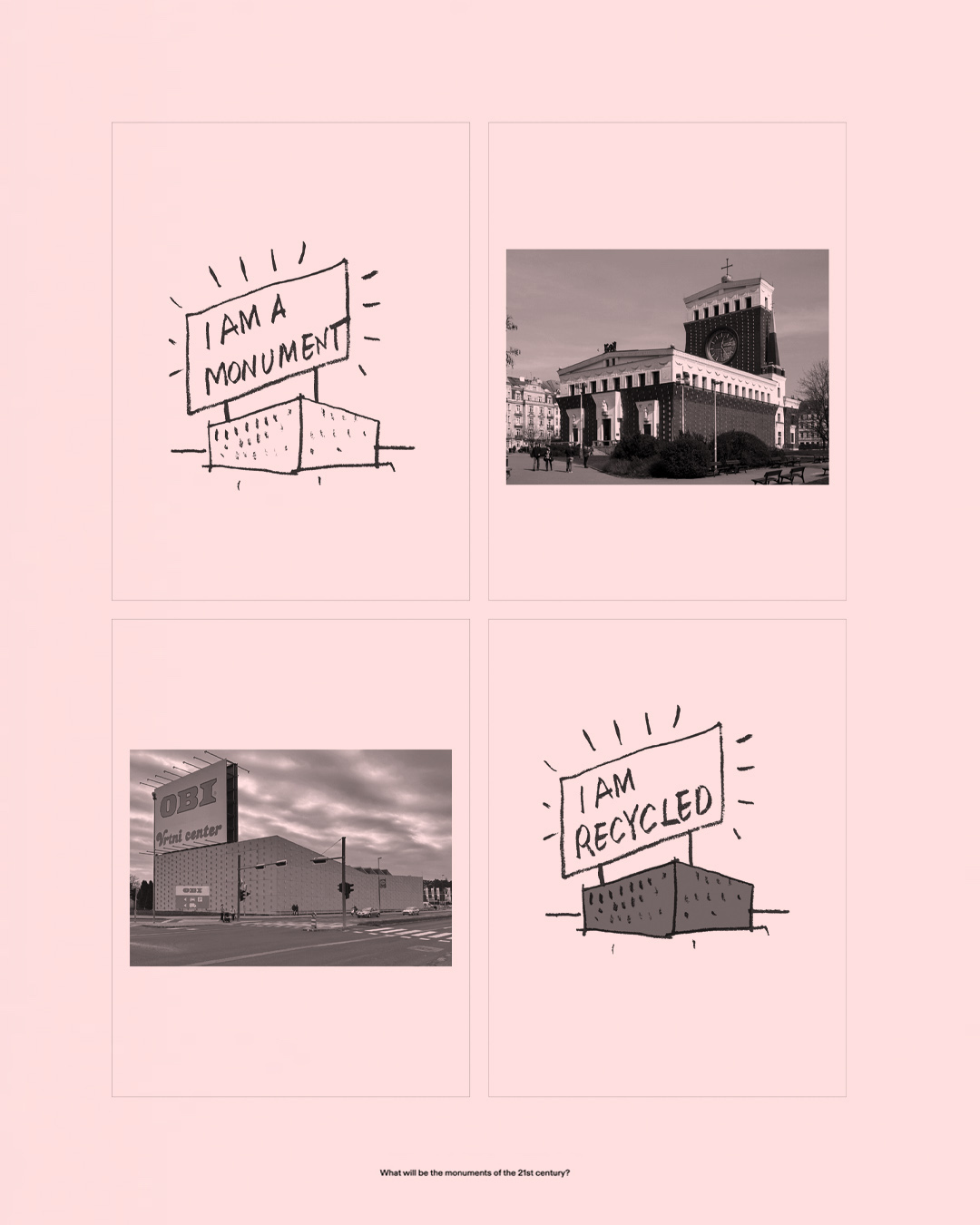
Fig. 1. Design as a Method of Inquiry: From Commercial Real-Estate Type to Peripheral Monument—Testing the Civic Potential of Transformation and Reuse

Fig. 2. Design Studios - Teaching Matrix with different transformation scenarios for existing strip malls in Austria

Fig. 3.
Learning from the existing landscape is a way of being revolutionary for an architect. Not the obvious way, which is to tear down Paris and begin again, as Le Corbusier suggested in the 1920’s, but another, more tolerant way; that is, to question how we look at things.
Learning from Las Vegas, 1972
Venturi, Scott Brown, Izenour
This research examines how low-status, car-oriented, and often monofunctional structures can be read typologically and transformed through architectural design to support more adaptable uses, richer collective life, and more responsible use of material and environmental resources. Rather than dismissing these strip-like agglomerations as haphazard accumulations or obsolete fabric awaiting demolition, it treats them as repositories of spatial, structural, and material intelligence whose latent capacities can be identified, tested, and developed through design.
Their transformation offers a means of developing new forms of civic architecture within the ordinary fabric of the contemporary periphery. Existing commercial and infrastructural types are examined as spatial and structural frameworks for light industry, laboratories, offices, and other forms of collective work and production. Retrofit, modification, extension, and localised replacement expand the range of uses and spatial relationships these structures can accommodate, while preserving and strengthening existing ecological assets. Their civic potential lies in how these interventions connect productive activities with shared facilities, public space, and the life of the surrounding territory.
The research proceeds through design propositions developed in master’s theses, design studios, and doctoral workshops. Architectural design serves as the primary mode of inquiry: it identifies latent capacities, tests the conditions and limits of their transformation, and gives spatial and material precision to proposed changes. These propositions make the civic and environmental potential of peripheral structures available for critical assessment.
Principal Investigator: Dr. Andreas Lechner
Buildings and construction processes cause about 40% of all CO2 emissions and can therefore make a significant contribution to tackling the biggest problems of our time – climate collapse and loss of biodiversity. This requires multiple paradigm shifts, which this project addresses in a little-researched segment of the planning and real estate sector: the countless retail, retail park and commercial properties that have been built on greenfield sites and connected to individual transport in recent decades.
Methods
In this cooperative R&D project, possible building and energy solutions for the climate-neutral city will be developed based on these monofunctional and underperforming building stock of the last decades. Based on architecturally and urbanistically sophisticated conversion and further development scenarios, existing buildings, conversions and extensions will be designed, modeled and computationally verified as an integrated and combined system for climate-neutral buildings and neighborhoods.
Contents and Goals
Can remodeling and rebuilding these substantial building inventories integrate more circular economy approaches? This seems counterintuitive at first, since for most of these properties only demolition, recycling, and renaturation are deemed reasonable, yet this project would like to use selected Austrian properties to develop scenarios that build on these existing resources and their infrastructure connections and think them toward more sustainably positive energy, use, life cycle, and social balances. Through the multiplication of space and uses - communal, logistical, sports and leisure-related programs, temporary/experimental residential and office uses, etc. – these properties could not only be structurally redesigned, further developed and equipped with state-of-the-art technologies, but also create socially sustainable, identity- and community-creating "third places” with the corresponding quality of stay and long-term profitability for society as a whole.
Results
The project connects key sustainability goals by building on extensive existing resources, designs the transformation and rebuilds them into more socially valuable "third" places of culture, and provides key data on cost, energy, and sustainability.
Summary
In the three-year CBT-research project selected commercial and retail properties provide empirical foundation as existing structures and resources for case studies that convert and further develop them towards more positive energy, use, and life cycle balances. “Placemaking” transforms the underperforming properties into more active and attractive places of higher experiential density and environmental relevance through multiplication of spaces and uses in the interior and exterior areas, demonstrating opportunities for more sustainable development of these understudied building typologies.
Project Partners
CBT is funded by the Austrian Research Promotion Agency FFG · Project Number #4425025 · ︎︎︎Final Report (German)
In the three-year CBT-research project selected commercial and retail properties provide empirical foundation as existing structures and resources for case studies that convert and further develop them towards more positive energy, use, and life cycle balances. “Placemaking” transforms the underperforming properties into more active and attractive places of higher experiential density and environmental relevance through multiplication of spaces and uses in the interior and exterior areas, demonstrating opportunities for more sustainable development of these understudied building typologies.
Project Partners
- Graz University of Technology - Institute for Design and Building Typology
- Graz University of Technology - Institute for Structural Design
- Graz University of Technology - AG Sustainable Construction
- University of Natural Resources and Applied Life Sciences Vienna BOKU - Department of Spatial, Landscape and Infrastructure - Institute for Spatial Planning, Environmental Planning and Land Use Management
- WMV Immobilien AG
CBT is funded by the Austrian Research Promotion Agency FFG · Project Number #4425025 · ︎︎︎Final Report (German)
Counterintuitive Typologies
TU Graz Research Group
Associate Professor
Dr. Andreas Lechner
Copyright
The information provided by the individual institutes and other facilities of Graz University of Technology as well as the other information providers is compiled independently by them, and entered into the system.
© Copyright unless otherwise indicated of Graz University of Technology, and of Andreas Lechner or the authors.
Privacy Statement · Datenschutzerklärung
For more information on privacy:
http://datenschutz.tugraz.at
Supported by cargo.site
Last update: 01/08/2026
Funded by FFG
Austrian Research Promotion Agency
![]()
![]()
TU Graz Research Group
Associate Professor
Dr. Andreas Lechner
Copyright
The information provided by the individual institutes and other facilities of Graz University of Technology as well as the other information providers is compiled independently by them, and entered into the system.
© Copyright unless otherwise indicated of Graz University of Technology, and of Andreas Lechner or the authors.
Privacy Statement · Datenschutzerklärung
For more information on privacy:
http://datenschutz.tugraz.at
Supported by cargo.site
Last update: 01/08/2026
Funded by FFG
Austrian Research Promotion Agency


Liability
The entire content of the Counterintuitive Typologies website has been compiled with the greatest care and to the best of our knowledge. However, we can assume no liability for the actuality, completeness and correctness of all the web pages. Content shall be removed immediately from the time that knowledge of a specific infringement of rights is obtained; TU Graz shall not be held liable before this time.
This website contains links to the websites of third parties; TU Graz has no influence over the content of such websites and shall therefore assume no liability for them.
The relevant information provider of the website shall be held responsible for the content and correctness of this information. When the link to the website of the third party was inserted, no infringements of rights were discernible. If TU Graz is made aware of an infringement of rights, the relevant link shall be removed immediately.
The content and works published on this website are subject to copyright. Any kind of reproduction, editing, dissemination and any kind of use beyond the limits of the copyright shall require the prior written consent of the relevant author.
When a user visits a website of TU Graz, information about his/her access (for example, the date, time, page accessed) can be stored. This does not constitute any analysis of personal data (e.g. name, address or email address). If personal data is collected, this is done so with the prior consent of the website user. Any transmission of the data to third parties shall not take place without the user’s express consent.
TU Graz states explicitly that the transmission of data on the Internet (e.g. by email) can pose security risks. Complete data protection against access by third parties cannot be guaranteed. TU Graz shall assume no liability for any damage incurred as a consequence of such security risks. The use of published contact details by third parties for the purpose of advertising is explicitly prohibited. TU Graz reserves the right to take legal action in the event that unsolicited advertising information is sent (e.g. in the form of spam emails).
Contact
︎︎︎ andreas.lechner (at) tugraz.at ︎︎︎www.AndreasLechner.at