(1) Research by design, (2) methodological inquiry, and (3) spatial research are three interrelated research streams that converge in Andreas Lechner’s forthcoming book, Counterintuitive Typologies.


Forthcoming book, Counterintuitive Typologies
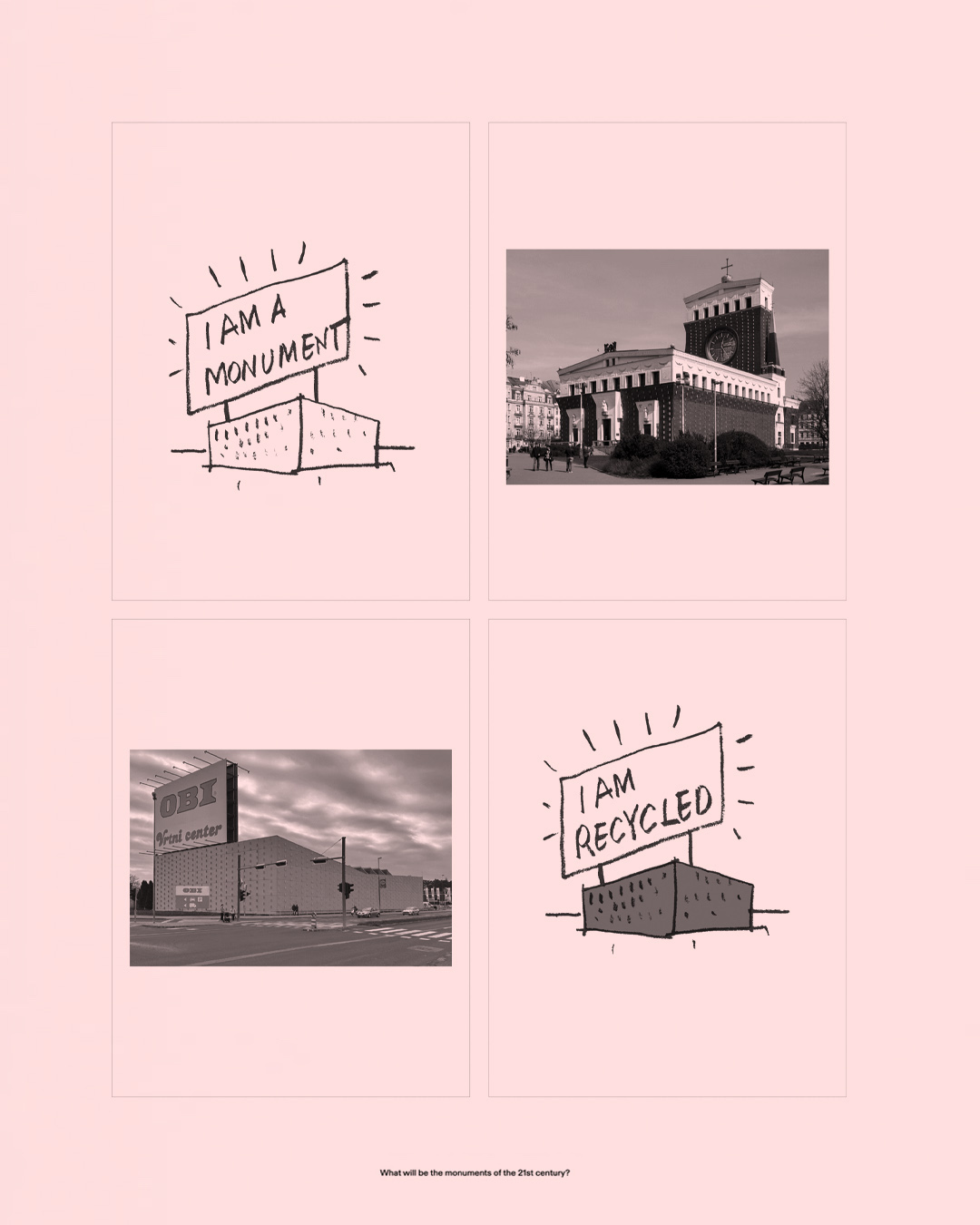
Counterintuitive Typologies completes a three-book trajectory on typology, drawing, and transformation. Thinking Design – Blueprint for an Architecture of Typology established typology as disciplinary knowledge: a mnemonic armature through which architectural history becomes operative in design. Architectural Affordances – Typologies of Umbau brought this argument into time, asking how existing structures both accommodate and are changed by successive acts of design. Counterintuitive Typologies extends the inquiry to the peripheral building stock: the capitalist vernacular of retail sheds, logistics halls, parking decks, office slabs, strip malls, and infrastructural landscapes.
The book’s central proposition is that structures commonly dismissed as generic and disposable may retain architectural capacities that exceed the purposes and economic calculations that produced them. Modularity, repetition, large spans, deep plans, and infrastructural connections can offer resources for transformation, while also imposing limits. These capacities are neither guarantees of adaptability nor intrinsic public goods. Typology becomes a method of critical inversion by reading such structures against their original economic logic and testing how design might redirect them towards new civic, spatial, and ecological purposes. This requires distinguishing what existing structures permit from what design introduces—and examining how ownership, regulation, finance, and access determine which possibilities can be realised, by whom, and for whose benefit.
The book develops a theory of post-productive architectural creativity through comparative drawing and design propositions. Here, post-productive names a shift in emphasis towards working with the material consequences of earlier production. As the architectural archive becomes increasingly reproducible and formal variation increasingly easy to generate, the precise reinterpretation and reorganisation of existing structures acquire renewed critical importance. The test is what transformation makes possible, what it costs, and what it excludes.
Counterintuitive Typologies positions the periphery as a principal site for this work: a terrain on which architecture must demonstrate how inherited structures can support collective futures —and recognise where their transformation cannot fulfil that promise.
Counterintuitive Typologies
TU Graz Research Group
Associate Professor
Dr. Andreas Lechner
Copyright
The information provided by the individual institutes and other facilities of Graz University of Technology as well as the other information providers is compiled independently by them, and entered into the system.
© Copyright unless otherwise indicated of Graz University of Technology, and of Andreas Lechner or the authors.
Privacy Statement · Datenschutzerklärung
For more information on privacy:
http://datenschutz.tugraz.at
Supported by cargo.site
Last update: 01/08/2026
Funded by FFG
Austrian Research Promotion Agency
![]()
![]()
TU Graz Research Group
Associate Professor
Dr. Andreas Lechner
Copyright
The information provided by the individual institutes and other facilities of Graz University of Technology as well as the other information providers is compiled independently by them, and entered into the system.
© Copyright unless otherwise indicated of Graz University of Technology, and of Andreas Lechner or the authors.
Privacy Statement · Datenschutzerklärung
For more information on privacy:
http://datenschutz.tugraz.at
Supported by cargo.site
Last update: 01/08/2026
Funded by FFG
Austrian Research Promotion Agency


Liability
The entire content of the Counterintuitive Typologies website has been compiled with the greatest care and to the best of our knowledge. However, we can assume no liability for the actuality, completeness and correctness of all the web pages. Content shall be removed immediately from the time that knowledge of a specific infringement of rights is obtained; TU Graz shall not be held liable before this time.
This website contains links to the websites of third parties; TU Graz has no influence over the content of such websites and shall therefore assume no liability for them.
The relevant information provider of the website shall be held responsible for the content and correctness of this information. When the link to the website of the third party was inserted, no infringements of rights were discernible. If TU Graz is made aware of an infringement of rights, the relevant link shall be removed immediately.
The content and works published on this website are subject to copyright. Any kind of reproduction, editing, dissemination and any kind of use beyond the limits of the copyright shall require the prior written consent of the relevant author.
The entire content of the Counterintuitive Typologies website has been compiled with the greatest care and to the best of our knowledge. However, we can assume no liability for the actuality, completeness and correctness of all the web pages. Content shall be removed immediately from the time that knowledge of a specific infringement of rights is obtained; TU Graz shall not be held liable before this time.
This website contains links to the websites of third parties; TU Graz has no influence over the content of such websites and shall therefore assume no liability for them.
The relevant information provider of the website shall be held responsible for the content and correctness of this information. When the link to the website of the third party was inserted, no infringements of rights were discernible. If TU Graz is made aware of an infringement of rights, the relevant link shall be removed immediately.
The content and works published on this website are subject to copyright. Any kind of reproduction, editing, dissemination and any kind of use beyond the limits of the copyright shall require the prior written consent of the relevant author.
When a user visits a website of TU Graz, information about his/her access (for example, the date, time, page accessed) can be stored. This does not constitute any analysis of personal data (e.g. name, address or email address). If personal data is collected, this is done so with the prior consent of the website user. Any transmission of the data to third parties shall not take place without the user’s express consent.
TU Graz states explicitly that the transmission of data on the Internet (e.g. by email) can pose security risks. Complete data protection against access by third parties cannot be guaranteed. TU Graz shall assume no liability for any damage incurred as a consequence of such security risks. The use of published contact details by third parties for the purpose of advertising is explicitly prohibited. TU Graz reserves the right to take legal action in the event that unsolicited advertising information is sent (e.g. in the form of spam emails).
Contact
︎︎︎ andreas.lechner (at) tugraz.at ︎︎︎www.AndreasLechner.at