(1) Research by design, (2) methodological inquiry, and (3) spatial research are three interrelated research streams.
(2) Reading Future Civic Armatures in the Existing
Developed through a fellowship, a collaborative research project, and a publication with the Department of Architecture and Urban Studies (DAStU) at Politecnico di Milano, this research strand investigates the productive intersection of typology and affordance theory.

Fig. Palazzo Madama, Turin (1st century BC–2023). A sequence tracing more than two millennia of transformation through yellow/red coding and annotations, as presented in Architectural Affordances – Typologies of Umbau (2025).
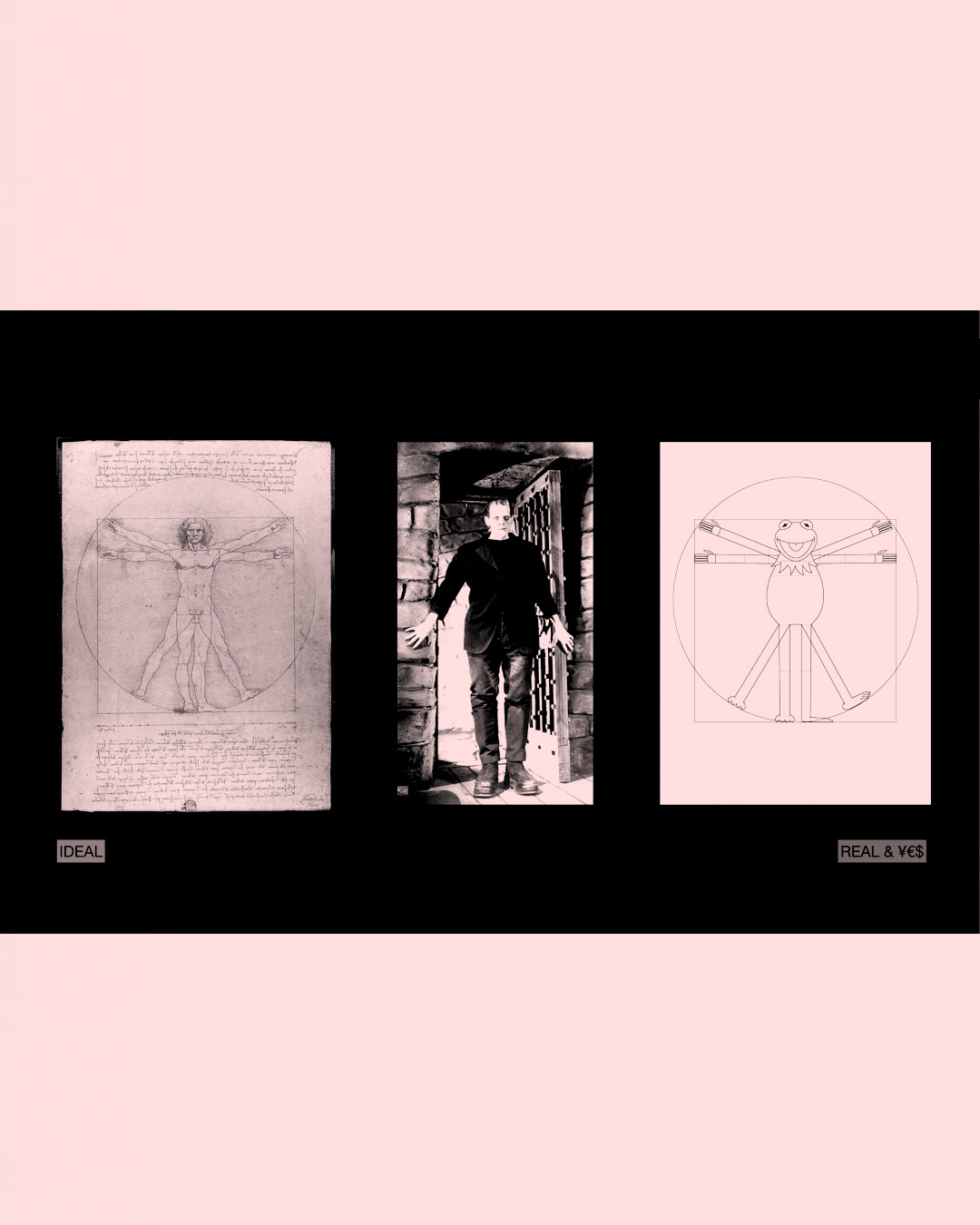
Fig. Suspended between the humanist ideal and the commercial realities embodied in real-estate typologies, Frankenstein’s monster provides an analogy for architecture’s hybrid practices and their methodological implications.

Fig. Cover, Architectural Affordances – Typologies of Umbau
Andreas Lechner, Gennaro Postiglione, Francesca Serrazanetti and Maike Gold, Naples: Thymos Books, 2025 · ISBN 978-88-32072-56-3
Disseminated through international conferences and peer-reviewed publications, the research extends typological inquiry beyond the classification of forms toward the recognition of architecture’s latent spatial, structural, material, civic, and transformative capacities. Typology is understood not as a system of fixed categories, but as an operative epistemic method for discerning what existing buildings enable, what they resist, and how their capacities might be reinterpreted and reactivated through design.
Drawing is fundamental to this methodology. It directs sustained attention toward empirical architectural objects, reconstructs their underlying spatial, structural, and material logics, and renders them available for comparison, critical reassessment, and transformation. Through drawing, the existing building becomes legible not simply as inherited form, but as a field of constraints and possibilities.
The principal outcome of this research is the book Architectural Affordances, which examines how buildings acquire, retain, and lose capacities for transformation over time. A shared drawing protocol distinguishes retained fabric, demolition, and addition, tracing successive material and functional changes in plan, section, and elevation. Comparative readings reveal how earlier architectural decisions both enable and constrain subsequent interventions.
Typology thus becomes a means of reading the relation between spatial persistence and changing use, while architectural affordances describe the possibilities that emerge between a building’s material configuration and the demands placed upon it. Together, they provide a framework for identifying how existing architectures might become future civic armatures rather than obsolete objects.
Architectural Affordances – Typologies of Umbau
Andreas Lechner, Gennaro Postiglione, Francesca Serrazanetti and Maike Gold, Naples: Thymos Books, 2025 · ISBN 978-88-32072-56-3
Link
︎︎︎Architectural Affordances
Counterintuitive Typologies
TU Graz Research Group
Associate Professor
Dr. Andreas Lechner
Copyright
The information provided by the individual institutes and other facilities of Graz University of Technology as well as the other information providers is compiled independently by them, and entered into the system.
© Copyright unless otherwise indicated of Graz University of Technology, and of Andreas Lechner or the authors.
Privacy Statement · Datenschutzerklärung
For more information on privacy:
http://datenschutz.tugraz.at
Supported by cargo.site
Last update: 01/08/2026
Funded by FFG
Austrian Research Promotion Agency
![]()
![]()
TU Graz Research Group
Associate Professor
Dr. Andreas Lechner
Copyright
The information provided by the individual institutes and other facilities of Graz University of Technology as well as the other information providers is compiled independently by them, and entered into the system.
© Copyright unless otherwise indicated of Graz University of Technology, and of Andreas Lechner or the authors.
Privacy Statement · Datenschutzerklärung
For more information on privacy:
http://datenschutz.tugraz.at
Supported by cargo.site
Last update: 01/08/2026
Funded by FFG
Austrian Research Promotion Agency


Liability
The entire content of the Counterintuitive Typologies website has been compiled with the greatest care and to the best of our knowledge. However, we can assume no liability for the actuality, completeness and correctness of all the web pages. Content shall be removed immediately from the time that knowledge of a specific infringement of rights is obtained; TU Graz shall not be held liable before this time.
This website contains links to the websites of third parties; TU Graz has no influence over the content of such websites and shall therefore assume no liability for them.
The relevant information provider of the website shall be held responsible for the content and correctness of this information. When the link to the website of the third party was inserted, no infringements of rights were discernible. If TU Graz is made aware of an infringement of rights, the relevant link shall be removed immediately.
The content and works published on this website are subject to copyright. Any kind of reproduction, editing, dissemination and any kind of use beyond the limits of the copyright shall require the prior written consent of the relevant author.
When a user visits a website of TU Graz, information about his/her access (for example, the date, time, page accessed) can be stored. This does not constitute any analysis of personal data (e.g. name, address or email address). If personal data is collected, this is done so with the prior consent of the website user. Any transmission of the data to third parties shall not take place without the user’s express consent.
TU Graz states explicitly that the transmission of data on the Internet (e.g. by email) can pose security risks. Complete data protection against access by third parties cannot be guaranteed. TU Graz shall assume no liability for any damage incurred as a consequence of such security risks. The use of published contact details by third parties for the purpose of advertising is explicitly prohibited. TU Graz reserves the right to take legal action in the event that unsolicited advertising information is sent (e.g. in the form of spam emails).
Contact
︎︎︎ andreas.lechner (at) tugraz.at ︎︎︎www.AndreasLechner.at